 Tourbillonnant 1000-1750 nm

Document purpose: Define the engineering controls required to achieve repeatable AM1.5G spectral matching across mass-produced LED solar simulators.
1. Scope
This document applies to multi-channel LED solar simulators designed for photovoltaic testing, solar-cell characterization, materials aging, and laboratory irradiation. It addresses spectral repeatability at the completed-system level.
It does not claim compliance with a specific simulator class. Classification must be verified against the applicable standard, test geometry, reference spectrum, and calibrated measurement method.
2. Design principle
AM1.5G matching is a closed-loop system requirement:
LED emitter selection + bin control + thermal control + optical architecture + channel control + spectral measurement + final calibration = repeatable spectral performance.
No single LED parameter can establish AM1.5G compliance.
3. Critical-to-quality parameters
| Parameter | Production risk | Required control |
|---|---|---|
| Longueur d'onde maximale | Spectral-channel shift | Approved bin range and incoming verification |
| Flux radiant | Channel-output variation | Flux binning and calibration range |
| Tension directe | Current and thermal variation | Driver compatibility review |
| Junction temperature | Spectral drift and output decay | Defined cooling architecture and operating limits |
| Drive current | Non-linear output change | Independently controlled, recorded channel settings |
| Optical geometry | Non-uniformity and spectrum mixing variation | Controlled mechanical revision and assembly tolerance |
| Measurement geometry | Non-comparable test results | Fixed target plane, distance, aperture, and method |
4. Recommended production flow
- Verify LED model, bin, lot, and incoming-inspection status.
- Assemble the light engine using the approved optical, conducteur, and thermal design revision.
- Operate the unit until thermal equilibrium is reached.
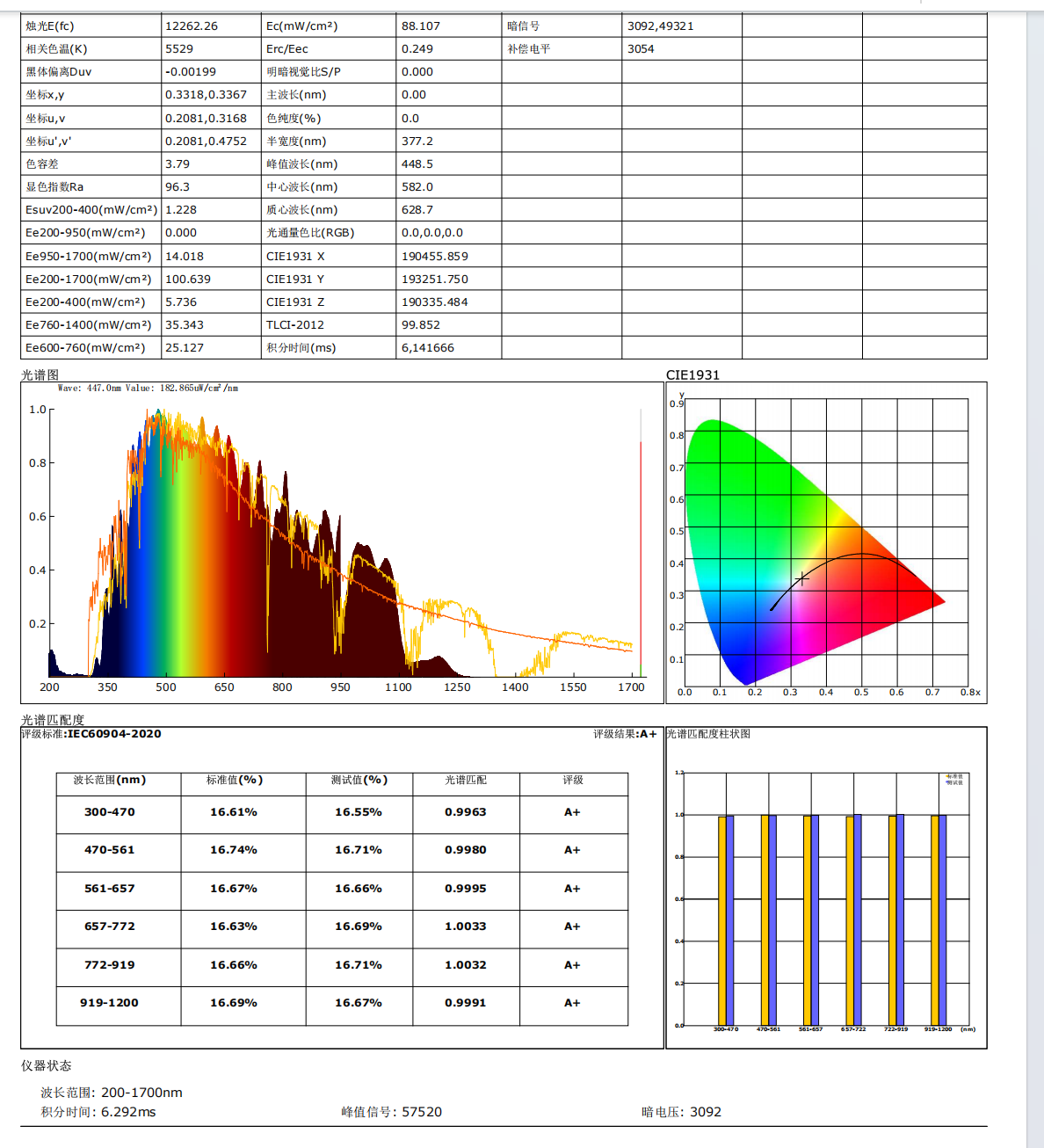
- Measure spectral irradiance at the defined target plane using a calibrated spectroradiometer.
- Compare the measured spectrum against the approved AM1.5G reference method.
- Adjust each LED channel within the approved drive-current operating range.
- Re-test spectral match, irradiation, non-uniformité spatiale, et instabilité temporelle.
- Store the final configuration and test record against the simulator serial number.
- Apply shipment release only after all defined acceptance criteria are met.
5. Calibration requirements
Calibration must be performed at the intended operating condition. The test procedure should define:
- Warm-up duration or thermal-equilibrium criterion
- Ambient and heat-sink temperature condition
- Target-plane location and illuminated area
- Spectroradiometer model, wavelength range, resolution, and calibration status
- Reference spectrum and calculation intervals
- Channel-current adjustment limits
- Recalibration interval and change-control trigger
Requalification is required after a change to LED source, LED bin, conducteur, optique, diffuser, cooling system, firmware, or measurement method.
6. Evidence package for technical customers
For each qualified simulator configuration, retain:
- LED part numbers, bins, and lots
- Spectral power distributions of installed channels
- Electrical and thermal operating conditions
- Channel-current calibration values
- Test-plane measurement geometry
- Final spectral-match results
- Irradiance, uniformité, and temporal-stability data
- Instrument calibration records
- Serial-number traceability

7. Supplier selection requirement
A suitable LED emitter or LED package supplier for solar simulator programs should provide spectral data, electrical and thermal conditions, package drawings, bin information, reliability documentation, and supply-change communication.
Shenzhen Yingfeng Opto-Electronic Co., Ltée. supplies LED emitters and LED packages across 200 nm à 2000 nm. The product range supports engineering evaluation of UV, visible, proche infrarouge, and infrared spectral channels for LED solar simulator light engines.
Contact:
Website: https://yingfengirled.com
E-mail: hehualan@chyingfeng.com
WhatsApp / WeChat: +86 18118737216
Technical references: ASTM G173, CEI 60904-9, and ASTM E927. Use the current applicable edition and confirm final results on the complete system.
