 LED de 1000-1750NM de giro

Um novo caminho de fototerapia não invasiva: Explorando a tecnologia LED UVB de 293 nm para pesquisa de vitamina D e osteoporose
Metatítulo: 293nm UVB LED para pesquisa de vitamina D e osteoporose
Meta descrição: Explore como a tecnologia LED UVB de 293 nm pode apoiar a síntese de vitamina D, pesquisa sobre saúde óssea e o desenvolvimento de métodos controlados, dispositivos de fototerapia não invasivos.
URL sugerido:https://www.yingfengirled.com/
Resposta rápida
UM 293nanômetro LED UVB é um emissor ultravioleta específico de comprimento de onda que está sendo investigado como uma fonte de luz controlável para a síntese de vitamina D e pesquisas sobre saúde óssea.
Pesquisas de laboratório demonstraram que a irradiação LED UVB de 293 nm pode estimular a produção de vitamina D₃ em amostras de pele humana. Pesquisas separadas em animais exploraram LEDs UVB de banda estreita para aumentar os níveis séricos de vitamina D e melhorar os indicadores de saúde óssea em ratos osteoporóticos.
Estas descobertas sugerem um potencial caminho de investigação não invasivo para pacientes que têm dificuldade em obter vitamina D suficiente através da luz solar., dieta ou suplementação oral. No entanto, 293nm A irradiação LED UVB ainda não é um tratamento estabelecido de forma independente ou universalmente aprovado para a osteoporose em humanos.
A tecnologia deve passar por nova validação clínica, otimização de dose, avaliação de segurança fotobiológica e revisão regulatória de dispositivos médicos.
Visão geral do caso de aplicação
Item Descrição Tecnologia Irradiação LED UVB de banda estreita de 293 nm Objetivo da pesquisa Estimulação controlada da síntese cutânea de vitamina D Aplicação potencial Deficiência de vitamina D e pesquisas sobre saúde óssea Equipamento alvo Dispositivo de pesquisa de fototerapia UVB portátil ou localizado Vantagem central Comprimento de onda preciso e exposição programável Nível de evidência atual Pesquisa laboratorial e animal Situação regulatória Não aprovado automaticamente como tratamento para osteoporose Requisito de engenharia Dose calibrada, irradiação uniforme e controles de segurança Por que a vitamina D é importante para a saúde óssea?
A vitamina D apoia o metabolismo do cálcio e do fosfato e contribui para a manutenção da mineralização óssea normal. Vitamina D insuficiente pode estar associada à absorção prejudicada de cálcio, redução da resistência óssea e aumento do risco de osteoporose em populações suscetíveis.
O corpo pode obter vitamina D através:
- Síntese cutânea desencadeada pela radiação UVB
- Alimentos contendo vitamina D
- Suplementos orais de vitamina D
- Tratamento clinicamente prescrito quando a deficiência é diagnosticada
A luz solar é uma fonte natural de UVB, mas a quantidade de exposição efetiva varia com a estação, latitude, hora do dia, roupas, pigmentação da pele, idade e estilo de vida.
Esta variabilidade encorajou os investigadores a investigar sistemas LED UVB controlados por comprimento de onda como um método mais reprodutível de estimular a produção de vitamina D.
Por que o LED UVB de 293 nm está sendo estudado?
Um LED UVB de 293 nm produz uma banda de emissão relativamente estreita em comparação com a luz solar ou lâmpadas ultravioleta de banda larga tradicionais.
Isso permite que os pesquisadores controlem:
- Comprimento de onda de pico
- Irradiância
- Duração da exposição
- Área de pele irradiada
- Distância da fonte de luz
- Dose UV total
- Frequência de repetição
Um estudo publicado relatou que a exposição ao LED UVB de 293 nm gerou vitamina D₃ em amostras de pele humana de forma mais eficiente, sob as condições de laboratório testadas, do que a comparação da luz solar usada naquele experimento. Este foi um estudo ex vivo e não deve ser interpretado como prova direta da eficácia do tratamento clínico em pacientes vivos. Resumo da pesquisa da Escola de Medicina da Universidade de Boston
A importância da pesquisa reside em demonstrar que um comprimento de onda UVB cuidadosamente selecionado pode estimular a produção de vitamina D usando uma exposição mais curta e controlada do que uma fonte não controlada de amplo espectro..
O que a pesquisa diz sobre LEDs UVB e osteoporose?
UM 2024 estudo em animais avaliou comprimentos de onda de LED UVB de banda estreita para regulação da vitamina D e saúde óssea. Os pesquisadores fizeram referência a experimentos UVB anteriores de 293 nm e posteriormente identificaram 297 nm como o comprimento de onda mais eficiente entre os comprimentos de onda selecionados em seu estudo de longo prazo..
Em ratos osteoporóticos, a irradiação LED UVB de longo prazo de 297 nm aumentou os níveis de vitamina D e foi associada a melhorias nos indicadores medidos de saúde óssea. Estudo animal de acesso aberto
Esta distinção é importante:
- 293evidência nm: produção de vitamina D₃ em amostras de pele e exploração animal anterior
- 297evidência nm: pesquisa animal de longo prazo sobre osteoporose com resultados na saúde óssea
- Evidências de tratamento da osteoporose humana: ainda insuficiente para fazer uma afirmação terapêutica definitiva
A pesquisa disponível apoia maior desenvolvimento e investigação. Não estabelece que um componente LED de 293 nm possa tratar de forma independente a osteoporose em humanos.
Uma via potencial de fototerapia não invasiva
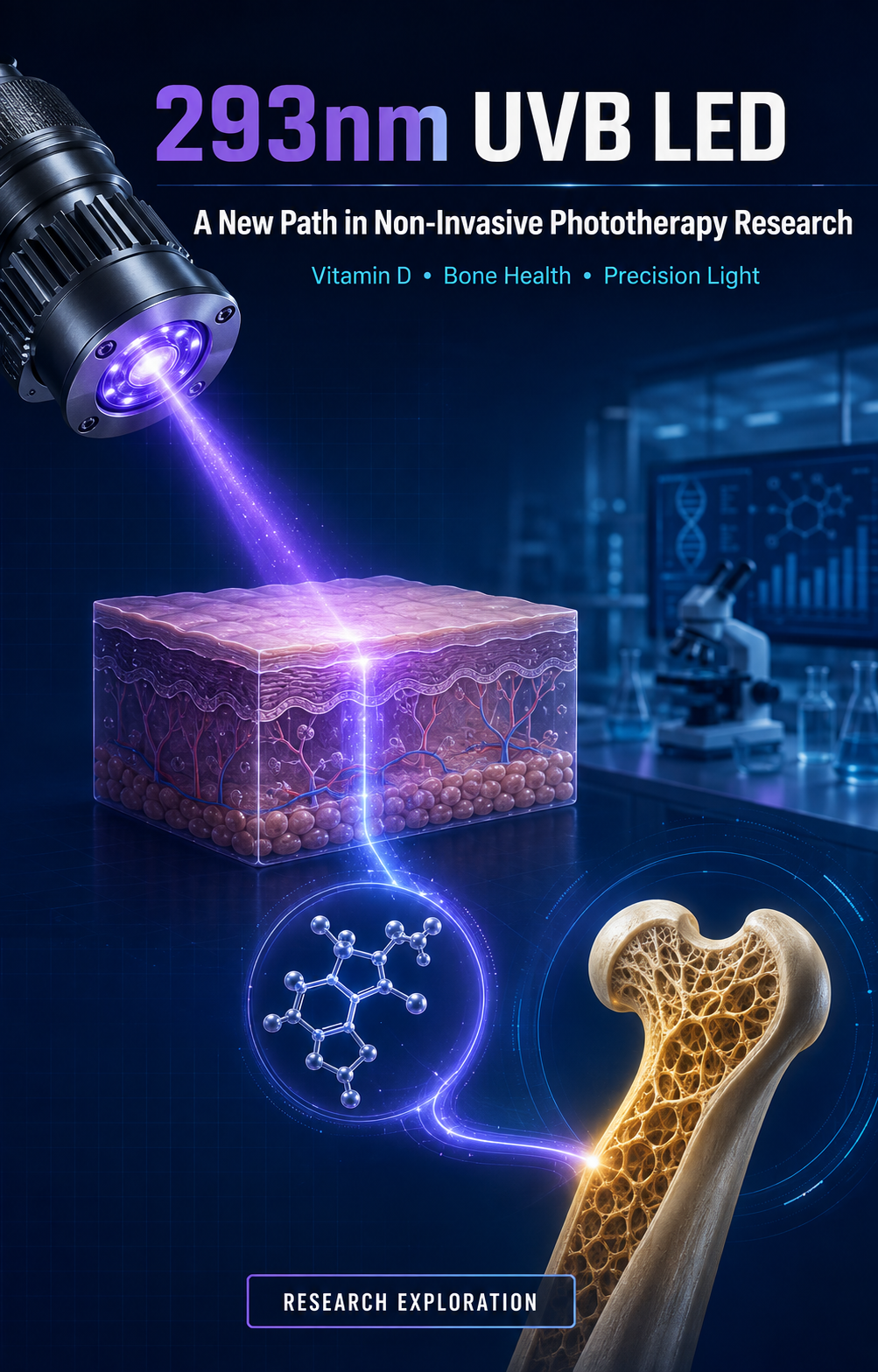
A via proposta baseia-se na exposição controlada da pele à radiação UVB de banda estreita.
flowchart TD
    A["293nm UVB LED"] --> B["Controlled skin exposure"]
    B --> C["Cutaneous vitamin D synthesis"]
    C --> D["Serum vitamin D research"]
    D --> E["Calcium and bone-health evaluation"]
O termo “não invasivo” significa que a luz é fornecida externamente sem injeção ou procedimento cirúrgico. Isso não significa que a exposição seja isenta de riscos.
A radiação UVB pode causar eritema, queimaduras, lesão ocular, envelhecimento prematuro da pele e danos fotobiológicos cumulativos se a dose não for adequadamente controlada.
Projetando um dispositivo de pesquisa LED UVB de 293 nm
Um dispositivo médico ou de pesquisa requer muito mais do que um emissor LED UVB de alta potência.
Um sistema completo pode incluir:
- 293matriz de LED UVB nm
- Pacote de cerâmica resistente a UV
- PCB com núcleo de metal ou cerâmica
- Driver de corrente constante
- Janela óptica de quartzo ou grau UV
- Sensor de irradiação
- Sensor de temperatura
- Temporizador de exposição
- Controle de distância da pele
- Intertravamento de segurança
- Desligamento de emergência
- Armazenamento de registros de tratamento
- Dissipador de calor e sistema de refrigeração
O dispositivo deve fornecer uma dose óptica repetível, evitando a exposição não intencional.
Parâmetros Ópticos Críticos
Comprimento de onda de pico e tolerância
Um produto rotulado como “293nm” pode não emitir exatamente 293nm em todas as unidades de produção. Os clientes médicos e de pesquisa devem solicitar a faixa de comprimento de onda garantida e o compartimento de produção.
Largura de banda espectral
Largura total na metade do máximo, ou FWHM, descreve a largura do espectro de emissão. A curva espectral completa deve ser revisada porque a radiação fora da banda desejada pode afetar tanto a resposta biológica quanto a segurança.
Irradiância
A irradiância descreve a potência óptica recebida por uma área definida e é comumente expressa em mW/cm².
Dose de exposição
A dose de UV administrada é calculada como:
Dose UV = irradiância × tempo de exposição
Para um sistema de pesquisa médica, a energia elétrica de entrada não pode substituir a irradiância calibrada e as medições de dose.
Uniformidade
A iluminação irregular pode criar áreas de superexposição e subexposição. O fabricante deve medir o mínimo, irradiância máxima e média em toda a área alvo.
Estabilidade de temperatura
À medida que a temperatura da junção do LED aumenta, a saída radiante e o comprimento de onda de pico podem mudar. O desempenho térmico deve, portanto, ser avaliado ao longo de todo o ciclo de exposição.
Requisitos de desenvolvimento propostos
Parâmetro Definição recomendada Comprimento de onda de pico 293alvo nm com uma tolerância especificada FWHM Verificado usando um espectrorradiômetro calibrado Irradiância Definido em mW/cm² na superfície de tratamento Dose Programado em mJ/cm² ou J/cm² Distância de trabalho Controlado mecanicamente e repetível Uniformidade Mapeado em toda a área de exposição Modo de operação Contínuo ou pulsado, claramente identificado Temperatura Monitorado durante cada exposição Segurança Temporizador, controles de intertravamento e proteção ocular Rastreabilidade Registros de lote de produção de LED e módulos Esses valores devem ser determinados através de pesquisas pré-clínicas, desenho de protocolo clínico e avaliação de risco. Eles não devem ser selecionados apenas com base em afirmações de marketing.
Vantagens potenciais sobre fontes UV convencionais
Um sistema LED UVB de 293 nm pode oferecer:
- Comprimento de onda precisamente selecionável
- Controle liga/desliga imediato
- Duração de exposição programável
- Dimensões compactas do dispositivo
- Irradiação localizada
- Controle independente de vários canais de LED
- Saída espectral indesejada reduzida
- Integração mais fácil com sensores e software
- Nenhuma fonte de luz contendo mercúrio
- Potencial para desenvolvimento de dispositivos de pesquisa portáteis
As lâmpadas UV tradicionais ainda podem oferecer vantagens para grandes áreas de exposição ou protocolos clínicos estabelecidos. A escolha deve ser baseada no desempenho medido, segurança, custos e requisitos regulatórios.
Segurança e conformidade de dispositivos médicos
A irradiação UVB nunca deve ser tratada como um recurso de bem-estar do consumidor sem controles de dose apropriados e avaliação médica.
Um dispositivo acabado pode exigir:
- Testes de segurança fotobiológica
- Testes de compatibilidade elétrica e eletromagnética
- Validação de software
- Engenharia de usabilidade
- Gestão de risco
- Avaliação de biocompatibilidade para materiais em contato com o paciente
- Evidência clínica
- Rastreabilidade de fabricação
- Autorização regulatória no mercado alvo
FDA descreve equipamentos de fototerapia ultravioleta como produtos ultravioleta médicos regulamentados. Os sistemas de fototerapia liberados geralmente incorporam saída controlada, uso de prescrição e recursos de segurança do paciente. Equipamento de fototerapia ultravioleta FDA
Um emissor ou módulo LED UVB de 293 nm é um componente. Não torna automaticamente o produto acabado seguro, eficaz ou aprovado para tratamento de osteoporose.
Como apoiamos o desenvolvimento de LED UVB de 293 nm
Para pesquisa médica e projetos OEM/ODM, um fabricante especializado de LED UVB pode oferecer suporte:
- Seleção personalizada de comprimento de onda de 293 nm
- Compartimentação de comprimento de onda estreito
- Embalagem SMD de cerâmica
- Solteiro- e emissores multi-chip
- Matrizes de LED personalizadas
- Seleção de lentes ópticas
- Mapeamento de irradiância
- PCB e design térmico
- Integração de driver de corrente constante
- Módulos UVB de vários comprimentos de onda
- Teste espectral em nível de lote
- Notificação de mudança de engenharia
Os clientes devem fornecer o comprimento de onda alvo, irradiância, área de exposição, distância de trabalho, tempo de operação, requisitos de uniformidade e limitações de resfriamento antes do início do desenvolvimento do protótipo.

Perguntas frequentes
Um LED UVB de 293 nm pode produzir vitamina D?
Pesquisas laboratoriais indicam que a exposição ao LED UVB de 293 nm pode estimular a produção de vitamina D₃ em amostras de pele humana. O efeito clínico em pacientes vivos depende da dose, tipo de pele, área exposta, frequência e outros fatores biológicos.
A fototerapia LED UVB de 293 nm pode tratar a osteoporose?
As evidências atuais não estabelecem a exposição ao LED UVB de 293 nm como um tratamento autônomo comprovado para a osteoporose humana. As descobertas existentes apoiam principalmente a pesquisa sobre vitamina D e investigações pré-clínicas ou clínicas adicionais.
Por que o estudo da osteoporose também menciona 297nm?
Os pesquisadores compararam vários comprimentos de onda UVB de banda estreita. Embora trabalhos anteriores incluíssem 293nm, o longo prazo 2024 estudo animal selecionou 297nm como o comprimento de onda mais eficiente em seu modelo experimental.
293nm é mais seguro que a luz solar?
Um LED de banda estreita pode reduzir a exposição espectral desnecessária e fornecer um controle de dose mais preciso. Isso não o torna inerentemente seguro. A segurança depende da irradiância, dose, área exposta, freqüência, resposta da pele e proteções do dispositivo.
O que os compradores devem solicitar de um fabricante de LED UVB de 293 nm?
Os compradores devem solicitar a curva espectral, tolerância de comprimento de onda de pico, FWHM, poder radiante, irradiância, dados térmicos, testes vitalícios, consistência do lote e condições completas de medição.
Um módulo LED UVB de 293 nm pode ser personalizado?
Sim. Comprimento de onda, Quantidade de LEDs, Dimensões da placa de circuito impresso, área de irradiação, óptica, motorista, o sensor e a estrutura de resfriamento podem ser personalizados para projetos qualificados de pesquisa e desenvolvimento de dispositivos médicos.
Conclusão
O LED UVB de 293 nm representa uma tecnologia promissora para a síntese controlada de vitamina D e pesquisas sobre saúde óssea.
Evidências laboratoriais apoiam sua capacidade de estimular a produção de vitamina D₃, enquanto pesquisas relacionadas com animais sugerem que a exposição otimizada de UVB de banda estreita pode influenciar a regulação da vitamina D e os indicadores de saúde óssea.
A conclusão responsável não é que a tecnologia LED UVB de 293 nm já cure a osteoporose. Em vez de, oferece uma precisão, plataforma programável e potencialmente não invasiva para a próxima geração de vitamina D, pesquisa sobre saúde óssea e fototerapia médica.
Solicite uma solução personalizada de LED UVB de 293 nm
Para uma avaliação técnica, por favor forneça:
- Comprimento de onda de pico alvo
- Tolerância de comprimento de onda necessária
- Irradiância alvo
- Área de irradiação
- Distância de trabalho
- Duração da exposição
- Frequência operacional
- Limitações de resfriamento
- Pesquisa pretendida ou aplicação de dispositivo médico
Nossa equipe de engenharia pode avaliar o pacote LED, configuração de matriz, óptica, PCB, driver e design térmico de acordo com os requisitos da sua aplicação.
Isenção de responsabilidade médica: Este conteúdo descreve pesquisas emergentes e aplicações de engenharia. Não constitui aconselhamento médico nem estabelece a exposição ao LED UVB de 293 nm como um tratamento aprovado para osteoporose ou deficiência de vitamina D..
- 1. Comprimento de onda alvo obrigatório * (comprimento de onda alvo desejado – Múltiplas seleções possíveis):
- 311nm UVB de banda estreita (Para fototerapia para psoríase/vitiligo)
- 305nm – 310nm UVB (Para síntese de vitamina D3)
- 280nm – 300nm (Para esterilização & Biosensorização Profunda)
- Espectro personalizado (280nm – 325Faixa nm)
- 2. Ângulo de feixe desejado * (Ângulo de luz necessário):
- ( ) 30° (Direcionado & Destaque Intensivo)
- ( ) 60° (Spread Médio para Patches)
- ( ) 120° (Vidro plano / Iluminação ampla e uniforme)
- ( ) A definir / Precisa de aconselhamento de engenharia
- 3. Formulário de produto necessário * (Formulário de produto obrigatório):
- ( ) Diodos LED SMD autônomos (3535 / 6565 Pacote Cerâmico)
- ( ) Módulo LED UVB integrado (PCBA personalizado com substrato de alumínio)
- ( ) Dispositivo de fototerapia médica finalizado (Colaboração OEM/ODM)
- Comprimento de onda: 280nm – 325nm (305nm/310nm otimizado) e Ângulos de feixe: 30° / 60° / 120°
Obrigado por ler, e se você quiser discutir como nosso Soluções LED pode caber em seus projetos, sinta-se à vontade para entrar em contato. O futuro de Tecnologia LED é incrivelmente brilhante, e mal posso esperar para fazer parte do que vem por aí!
